Saturday, July 19, 2014

goTenna


via Brick O'Lore

The goTenna is a device the size of a ruler that purports to allow cellphone users to communicate over long distances without a cell tower. It's a 151-154Mhz data radio with a lithium-ion battery and a Bluetooth Low Energy link to your cellphone. So far I have not found any specs on data speeds, specific frequencies used or anything else. The radio will output 2W. It is pending FCC approval as well.

To use it you pair your Iphone, Ipod, Ipad or Android device running 4.0 or higher Android to it over Bluetooth and then use their apps. There's a texting app and an app for sharing your position on a map. Apparently you can do broadcast messages to all goTennas in range. For person to person communications it is encrypted, otherwise for the broadcast messages it is unencrypted.

$150 for a pair right now, but later that will go up to $300 for a pair.

There's a few things I think that are interesting about this device. One use-case is talking about using it in a power outage. It's been a while since I've seen something targeted at consumers that didn't assume the Internet will always be available. Another thing I noticed is the smartphone is the entire interface to this device and drives some of the functionality. It doesn't need a GPS, just use the one already in your phone.

Astute hams will say this is just APRS. I would disagree. It's far more polished than that. I don't see any portable APRS configurations that can be worn on your person that are anywhere near as uncomplicated while being as powerful as this. A few HTs might be getting close, while still requiring tethers. Much like the earliest VCRs with their wired remotes. Surely some people have used Bluetooth or Wifi to serial adapters to go wireless. We're still talking 2-3 devices plus cabling plus power for each.

I do think the price is out there though. Not sure that these will catch on. Plus it's an expensive bauble to lose or have stolen. Not sure how they are using the frequencies they are using either.

EDIT: It occurred to me some time after making this post that they are probably using MURS frequencies.
ChannelFrequencyAuthorized bandwidthChannel Name
1151.820 MHz11.25 kHzN/A
2151.880 MHz11.25 kHzN/A
3151.940 MHz11.25 kHzN/A
4154.570 MHz20.00 kHzBlue Dot
5154.600 MHz20.00 kHzGreen Dot
via Wikipedia

That fits the 151-154Mhz profile and the 2 watt power output. MURS also allows several data modes. I don't see any specified data modulations so it probably depends on what will fit in the channel and be reliable over range. I imagine they probably use something low speed though, 1200-9600bps.

Sunday, May 25, 2014


Saw this on Hackaday and had to share it. This guy has figured out how to embed a small copper wire in his extruded plastic from his 3d printer. It's very basic at this point as there's no way to have the machine cut the wire, or to hook it up to anything. This could be the beginning of the ability to 3d print circuits. Some example applications he lists for this include:

  • Coils
  • Antennas
  • PCBs
I imagine these are of interest to other ham radio operators. Another example might be printing an RFID tag with an antenna built it, then add on an AVR chip and a couple of components for a complete homebrew tag, such as in this blog post.

3D printing as a whole is still a very young hobby. You could compare it to ham radio at the very beginning with the spark gap transmitters and no regulating body. Or even hobbyist computing in the 70s when you had to build your own computer if you wanted one. The machines are slow and require a lot of fiddling to get a good print. But there's lots of experimentation, not much is set in stone yet and there's a lot of discoveries to be made.

Sunday, May 26, 2013

PL-2303 Troubles cannot start device code 10

Having to deal with this issue, again, lately gave me the idea for this post. Ever buy a radio programming cable, or a cheap USB-Serial adapter, only to plug it in and have Windows tell you that there was an error installing the device? Typically, when you go into the device properties it tells you that it "Cannot start device (code 10)".

Prolific is the original manufacturers of the PL-2303 chip. It is a single chip device that plugs into a usb port on one end and gives you a normal RS-232C serial port on the other. The chip got popular enough that other Chinese manufacturers cloned it. I'm not sure if they cloned the exact chip, or if they made one that does the same function but uses the same protocol as the PL-2303 chip and uses the same drivers. At first, when these chips came out the version of drivers which existed would work 100% with these clone chips.

Prolific didn't like this however. They have a good reason I'm sure. Since clone makers tend to ride on the coattails of the authentic chips, the authentic manufacturer gets to deal with people coming to them when things don't work. So it's an issue of supporting chips that you didn't make and you didn't profit off of. What they did, I've read, is add a check into the newer versions of the drivers so that they check for a specific response from the chips. If it responds with 1 code then it's authentic and the drivers work, if it responds with another code then they know it's not authentic and the drivers give you the oblique error message.

It's been awhile since they changed the drivers to add this check in, so it's rather hard to find older drivers that work in Windows for your new serial adapter.

Prolific has a good reason for doing this, but it really only hurts the end user who buys a device that doesn't have an authentic chip in it. It's not like the end user can check to make sure it does, or even knows that it might not have an authentic chip before they buy it. Some locations to buy these are also not receptive to returns either. It's possible that someone could lose some money buying a cable that they don't have the expertise to fix. Moving up the chain, it's even possible for the people who are designing the cables to errantly use unauthentic chips even if they think they are buying the real deal. Some of the older drivers do still exist that work with the clone chips, and I'm willing to bet that the Linux drivers are not hobbled in the same manner.

Given all of the difficulties with these chips, why can't an alternative show up to replace them in designs? I think even if someone could produce an open-source adapter design using an inexpensive PIC chip or similar with USB support then that would benefit a lot of people. If I find a list of alternative chips later, I will append it to this post. Maybe an open-source project has already been accomplished if this page about LUFA is any indication.

Shameless plea to radio manufacturers: Please build USB support into radios. Please? It would be beyond great to have a micro-usb port on one side of the radio that could accept a standard usb cable for programming. (Trickle charging would be a good benefit as well, but I won't push it.) Seriously, I have separate, incompatible, cables for my new Baofeng, my Icom R3, my Yaesu FT-50R, a Puxing PX-2R and I think one or two older radios floating around. In the future, I should be able to get all new radios with a micro-usb port and just use the same cable as I do for my phone to plug into my computer for programming.

Sunday, May 19, 2013

Hamvention 2013

Had some fun at the Hamvention today. Saw a lot of APRS equipment. This was also apparently the year of solar panels.. noticed a fair few of those in the flea market. Got a terrible sunburn on the back of my neck. Also had to cut my visit a little short because of a bad migraine, guess I was overdue for one.

Noteable mentions:

  • Codec2 booth right next to a D-Star booth, nice place! Wish I had asked about the prototype HT of the future but other people were in conversations and I didn't wait around very long.
    • Was talking to someone in the flea market about an Icom 2200H and asking about D-Star (which the radio didn't have that card in it) and had someone stop by to comment on the proprietary nature of D-Star driving the extreme cost. Which I agree with and it's good to see that Codec2 is having a positive impact here by providing a more Ham friendly alternative to the closed, proprietary nature of the AMBE codec that D-Star uses. (And the weird, open/closed protocol too)
  • Yaesu FT-1DR at the Yaesu booth. I see now it has a price on Universal-Radio, $540. It's approved by the FCC with an expected release date of June 15th.
    • GPS is built in.
    • Has a Group Short Message function that I expect should be like cellphone texting
    • Neat sounding Group Monitor function - ARTs on steroids?
  • TinyTrak
  • 2 or 3 portable terminal boxes for backpacking digital modes. Can't remember the names of them now and didn't grab any papers while I was there (sorry!). One could do CW, PSK and RTTY. The ones I saw had the old usual 4 line by 20 character displays
  • Elecraft had some neat things like the K3/0 Mini.. Remote control for a K3 in what looks like the style of a KX3. (So much so that the card next to it said "Yes, this IS the new K3/0 Mini")
  • Neat demonstration at a ATV booth of the differences between analog ATV and Digital ATV (DTV). Output of a DVD player (or Bluray?) run through both types of transmitters at once into a (slightly damaged) Digital TV. Guy giving the demonstration showed both signals with attenuation to show different reception signal strengths. Digital signal stayed perfectly clear down to 80db down, but disappeared at 82 or 83db. Analog was very fuzzy when you could still receive Digital but could be received even when Digital cut out completely. Effective demonstration.
  • Uhm, there was a digital DMR booth somewhere that someone had a digital radio the size and shape of a cellphone, even looked like one a bit. Very cool! Didn't stick around to ask questions because right then there was a group picture. Meant to go back later though.
  • AMSAT and QSO radio show were both showing and talking about nano-satellites. QSO radio show was talking about a dual-band FM cube satellite that had 400mw transmit power which is enough from space, and each side will have a 1w solar panel. It had 10 pcbs stacked on the inside. Kinda neat. AMSAT had one with bits and pieces and one complete (model?). There was a board transmitting a saved voice ID on a timer.
  • Not really related to the show but I want to throw out there: The Internation Space Station recently switched to Linux from Windows.
  • Import Communications had some neat things. Wouxun radios, Baofeng radios (I bought one of those with all the goodies), and the X1M QRP SSB/CW transceiver which I was sorely tempted to buy. (But held off, I have a perfectly fine HF radio.. my problem is I need an antenna for it)
  • SDR goodies here and there.
Didn't really run into anyone I knew. Half the time I was looking at the various wares people were offering (and I'm pretty sure there was some warez too, at least two booths selling DVDs of electronic manuals that had scans of old QST magazines or Elector Electronics magazines that I'm not sure were officially licensed) and half the time I was looking at faces for some that I recognized. Allwell, this year was fun. If I can go next year, things that I want to do different are:
  • Try and get off Friday.. I've never been on a Friday
  • Hope it doesn't rain on the day I go like this year
  • Wear sunscreen, good grief.
  • Go to a forum or two?
Some things that I was looking for but didn't find:
  • Raspberry Pi - Did I miss it?
  • Arduino - should be a slam dunk, I did see someone selling a custom PIC (I think) platform for ham applications and I did see someone selling things that were compatible with the Raspberry Pi or were an Arduino shield.
  • Boatanchors - Just Kidding. It'll probably be Hamvention 2113, most hams on Earth will be using subspace or quantum tunneling or 100 Ghz nanotechnology wifi mesh, and someone will still be selling old Drake and Halicrafters radios.
I could've done without the cloud of poisonous cancer causing chemicals that I got the pleasure of breathing every time I went in or out of a door.

Friday, May 17, 2013

vv-808 Mobile Transceiver update

Found the cheap mobile I saw yesterday even cheaper, by way of someone selling it with a $10.55 shipping cost.

http://www.aliexpress.com/item/VV-808-two-way-radio-mobile-transceiver-walkie-talkie-cheap-price-car-radio-Fujian-China-FM/865228480.html

Here it is on Aliexpress for $68.55 shipped. The seller doesn't have any feedback yet though. The only other seller is doing the thing where shipping is $70. I imagine these are going to start showing up more and more on there with time. If anyone gets one, send me a message about it?

Thursday, May 16, 2013

Hamvention

Just a little warning, I might go a little nuts posting over this weekend. I'm going to the Hamvention on Saturday, like many other people, and I'm probably going to repost some news if anything noteworthy shows up during, before or after the show.

Ten Tec 506 Rebel

http://qrper.com/2013/05/ten-tec-introduces-the-model-506-rebel-an-open-source-qrp-transceiver/
It's a 20/40m QRP CW radio. The neat thing though is that the CPU in it is Arduino powered. The whole thing has standard connectors and all kinds of standard, easy to work with, parts. The complete opposite of ridiculously expensive closed systems like the Icom D-Star radios. I think it would have been more fun if it wasn't just CW only. Even something geared more toward digital modes than voice would have been nice. Still, this is a very good direction to go in after tons of radios that are completely closed off (and really fly against Ham radio tradition) or radios that are otherwise built completely without digital components at all.

Not that there's anything against roughing it with the same functionality as radios had 50 years ago for nostalgia... but there will be no innovation if you just do the same thing you've always done. Without innovation, Ham radio is doomed.

Now I'm waiting for a series of radios that include an empty bay for taking things like a Raspberry Pi or Arduinos or whatever you can squeeze in it.

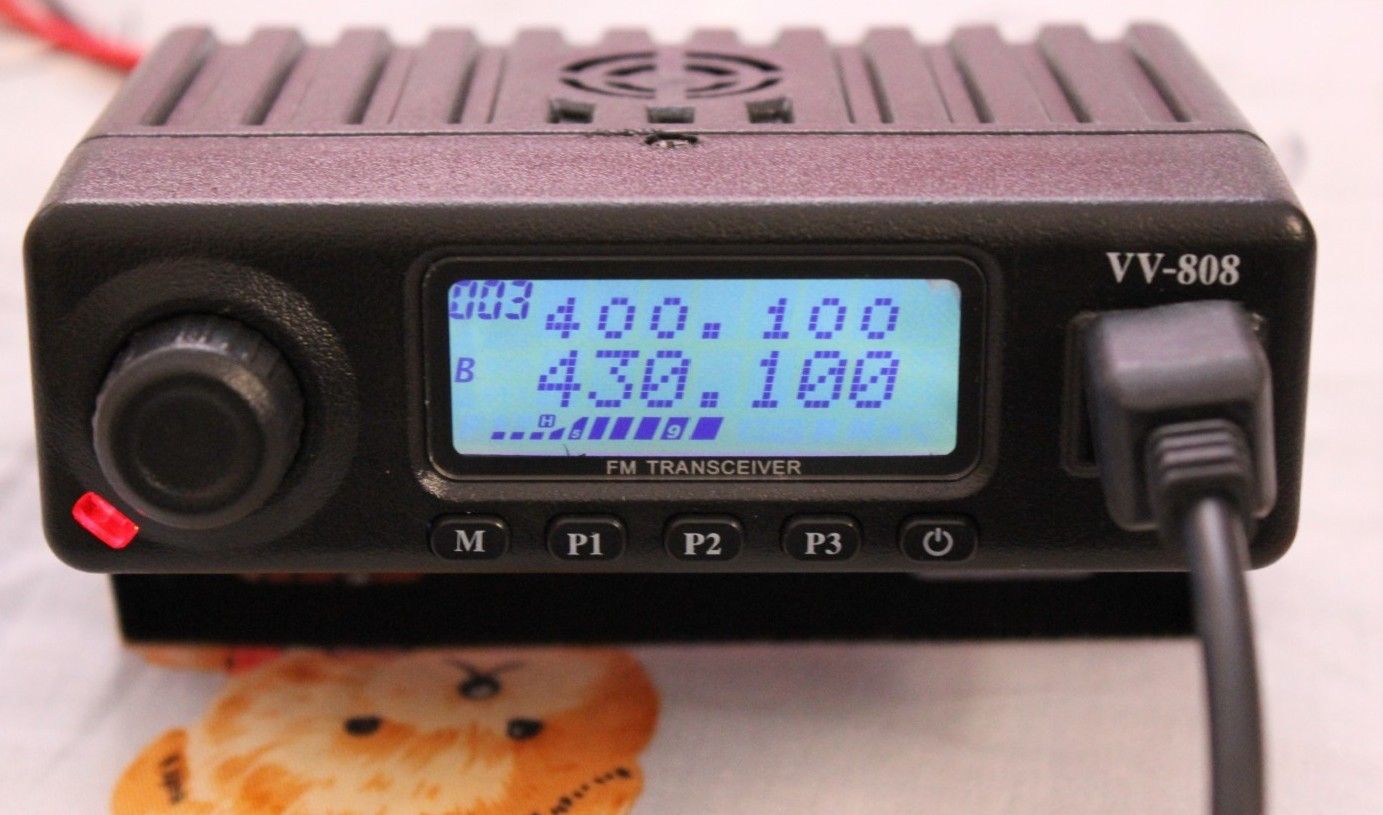
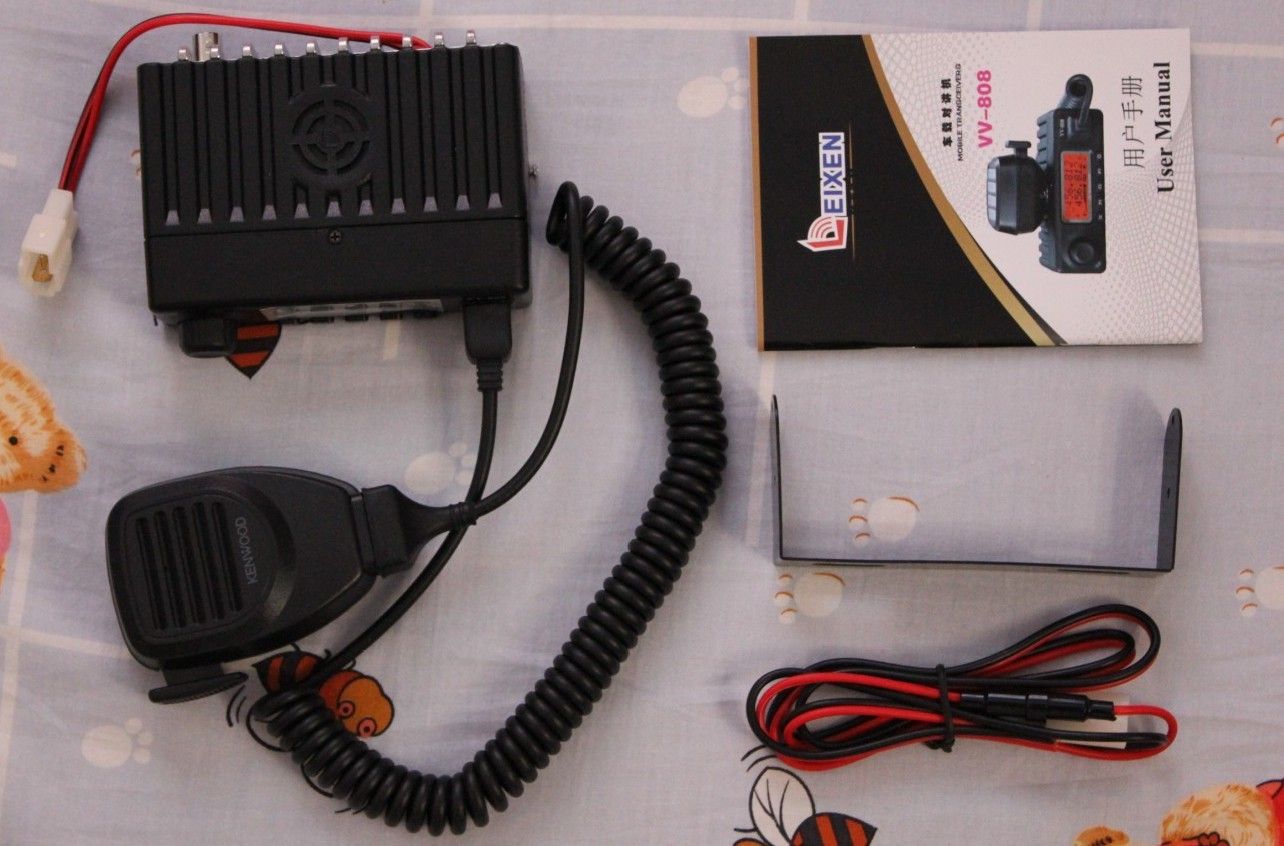
VV-808 Mobile Transceiver

http://www.dhgate.com/vv-808-mobile-transceiver-10w15w-two-way/p-ff8080813bade0f0013bb685146e05d1.html#s1-1-1


$134 shipped ($65.71 of that is the shipping cost, $68.29 for the radio.)

Found this one talked about in a post on the Baofeng UV5-R mailing list. I'm still not sure if this is single or dual band. The listing says 136-174mhz or 400-470mhz. But the listing also says Dual Reception/Dual Display so that could mean it's dual band or it could mean it monitors two frequencies on one band (by switching between them) and they're counting on the terminology to confuse someone. Anyways, if it is dual band it happens to be the cheapest Chinese radio I've ever seen. If not, it's not that good of a deal. Single band mobiles aren't that expensive.

The radio looks TINY. It's my theory that they put the pcb of a handheld in it and made a beefier amplifier circuit. Not much though, 10W/4W on VHF. Maybe 15W on UHF? Again, ambiguity in the specifications.
Size: 120*85*40mm

Just look at that.

X1M MKII 20W QRP SSB CW Transceiver

http://www.kightradio.com/X1M-MKII-20-Watt-QRP-SSB-CW-Transceiver_p_319.html


Wow, this looks pretty cool actually. They don't have a price listed yet though. Check out the connections on the back:

  • GPS ant.
  • IF out
  • I&Q out
  • ACC1&2 (Hope at least one of these are CAT)
  • VGA(!) Probably goes with the color LCD on the front
  • ATU
  • 12v Power
  • Antenna
Note that the front seems to say "HAM Toy" in the corner, how true. 
HF-6M I read somewhere that it was all the way from 160 meters up. Don't know if it has band limits. Hope so but this is Chinese in origin so probably not.

Sunday, April 14, 2013

MSP430 new post on Morse Code in Energia project

http://blog.jamesrhall.com/2013/04/msp430-morse-code-in-energia-part-2.html
Posted on my other blog on my portfolio website.
Now you can set a callsign, or a sentence up on a String variable and the program will take care of the rest.
Supports letters, numbers, space and a couple of punctuation. @ and !

Wednesday, April 10, 2013

Elecraft K3/0 and Ham Radio As A Service

I was browsing through the May 2013 issue of QST when this article caught my eye. "RemoteHamRadio Station Network" on page 59. Basically it's a subscription service over the Internet where you pay $2999-$6999 a year to access some so-called mega stations somewhere. The article is vague but includes a url to www.remotehamradio.com

The website has more information. There are 3 stations. The lowest priced plan has a per-minute usage charge and the more expensive plans include a set amount of minutes each month after which you pay the per-minute usage charge. I believe this is to discourage someone from hogging a site and not allowing other people to use it.

The big deal is that part of your subscription includes (it's on a lease!) an Elecraft K3/0.
Picture from official website http://www.elecraft.com/K3-Remote/k3_remote.htm

The Elecraft K3/0 is a remote control for an Elecraft K3 transceiver. It doesn't actually have any RF components inside. It's meant to pair with a standard transceiver and give you the feeling of being there. I'm unsure if you can do so without using the RemoteRig box as well. It's the smaller box sitting on top of the two K3s above. The purpose of that box is to pass control signals and audio between the Remote and the Transceiver boxes and it can also work over the Internet as well.

Prices to buy this stuff at Elecraft directly
Elecraft K3/0 price $695.95
RemoteRig price $499.95
Cable Set for each side $49.95/ea
So roughly $1300+shipping+K3 transceiver to set this up yourself.

That doesn't include the price for amplifiers, antennas and the cost of the location and other overhead for things like power, network connectivity, cooling/heat and so on. The yearly price is very expensive (The top end could be a house payment) but once you figure in all of that stuff it quickly becomes obvious why. Trying to figure out if this is worth it to you really comes down to if you can do it cheaper or not, if you can do it at all or not, if you can get by with less of a system (I think most can, really), and if it gets to be too busy to be worth it for you. I can well imagine someone using all of their monthly allotment of time during a busy contest and that putting others out. Frankly, to me, it really feels like the equipment should be a buy and not a lease. You're already paying well over the purchase price for the equipment they send you even if you pick the lowest priced plan. I'd like to see this addressed with a policy for Bring Your Own Devices giving a lower monthly cost at least, if not a lease converting to a purchase depending on the plan and the length you subscribe as with cellphones.

Makes me want to try to put together something similar using Raspberry Pis though.

Just a disclaimer, my views are my own and don't represent the views of any person or company mentioned in this post. Nothing precludes you from having a home base and one of these services. I'm not even advocating for it, just another aspect of the hobby.

Saturday, March 16, 2013

V689U Chinese Digital Radio

I noticed the teaser for this radio on 409shop's website when I was looking up the current prices for the UV-3R radios. I've actually seen a different radio on Alibaba recently too but my inquiries are ignored or responded to by telling me that radio isn't ready yet.
According to these links:
http://www.brickolore.com/2013/03/409shop-teaser-v689u-digital-radio.html
http://www.brickolore.com/2013/03/v689u-kirisun-s760fp460.html
http://hamgear.wordpress.com/2013/03/13/chinese-digital-radios-theyre-here/
It's similar to, or it is actually this radio made by Kirisun:

http://en.kirisun.com/detail.aspx?id=61&zhu=1&Cyrus=1
I'm not sure though because the Frequency list here doesn't seem very useful for Amateur Radio needs. Another link that I've been to lists it as 400-470Mhz which would be useful and fairly standard actually for Chinese radios. It can do analog FM and digital modulation. All the details I can find on the digital is that it is 4FSK and it can create two 6.25Khz channels in a 12.5Khz frequency space which kinda sounds like TDMA?
It'd be cute if these were firmware reprogrammable and you could do codec2 on whatever chip is inside. I have a feeling it's the same old awful IMBE/AMBE type chips that you can only get through DVSI, like on D-Star. Of course this is coming from China, I guess it's possible they've reverse engineered those codecs and put them on a chip that can be reprogrammed to codec2 one day. That would make this radio more valuable. I just read on the hamgear link that they will be software updateable. So you can add more features, but no idea if that would include the codec or not. I'm guessing not, but we can always hope so.

Word is the pricing is going to be $200. A lot more expensive than other Chinese radios but you have the digital price premium to pay. (And the DVSI tax if it does use the DVSI chips)

Baofeng UV-3R flashed

Lior is at it again, this time he's working on the Baofeng UV-3R radios. The MCU that runs the radio is flash programmable. Unfortunately the security bits are set so you can't read out the existing firmware first, but you can erase it and insert your own. A group is forming on the Yahoo Groups board to work on making a 100% community made firmware for these radios.
http://groups.yahoo.com/group/UV-3R/message/8141 This is the thread talking about the initial experiment. See this Youtube video:


http://groups.yahoo.com/group/UV-3R/message/8158 This is a thread where people are talking about what features they want to have in a community made firmware.
One thing to note, during the tests the PA circuits are turned off so it's outputting very low power. Too bad the radios are FM only, because that would be a good thing for transverters.. Hey, maybe it wouldn't be bad for the SHF stuff?
Could be good for fox hunts too.. Just flash it with a firmware to send the MCW occasionally and then hide it, no extra circuitry required.
These radios are pretty inexpensive at $41 each. I can well imagine quite a few things they could be used for if they are reprogrammed with a new firmware. Of course I have no illusions that the chip is powerful enough to do very complicated things. I am hoping this opens the door to a community who buys these radios for this purpose and then the companies respond to that by making more radios which can be flashed. Especially if they put more powerful chips in them and a few years down the road it's possible to flash codec2 onto one and have a very inexpensive digital radio.
I doubt that's possible with these. Maybe a 1200 baud packet firmware will come out though. Then you'd have a very inexpensive APRS tracker just by adding a GPS.

Thursday, February 21, 2013

Radio hacking: Baofeng UV-5R edition

http://groups.yahoo.com/group/baofeng_uv5r/message/20888
This rather industrious individual has been working on replacing the main CPU in his Baofeng UV-5R transceiver. These are cheap radios of course, but one of the neatest things is that they are cheap partly because they have a lot of functionality integrated. If I understand it correctly, there's a chip that basically handles everything for the radio functionality and then you have a CPU that controls the whole shebang over an SPI interface. The radio chip is an RDA1846.
The RDA1846 is a highly integrated single-chip transceiver for Walkie Talkie applications. It totally realizes the translation from RF carrier to voice in the RX path and from voice to RF carrier in the TX path, requiring only one micro controller.

The RDA1846 has a powerful digital signal processor, which makes it have optimum voice quality, flexible function options, and robust performance under varying reception conditions.
 Cut the power to the main mpu and that frees up the bus to communicate with the radio chip. In Lior's case, the SPI connection became damaged so he was able to enable I2C mode. He is using an Arduino so it actually works out to be easier to interface.


One neat thing he's already discovered is the ability to direct the RDA chip to produce sinewaves at any audio frequency and here his is demonstrating that by transmitting his callsign in morse code. According to him, 1200 baud FSK is even possible. That's just cool.

He has a page available here: http://www.liorelazary.com/index.php?option=com_content&view=article&id=49:hacking-the-baofeng-uv5r&catid=14:baofeng-uv5r&Itemid=17
This has more information and he may also work on the Baofeng UV3R at some point.

Incidentally in the discussion somehow a link to a bluetooth module was posted: http://dx.com/p/pcb-bluetooth-module-blue-140788 It'd be really neat to integrate a bluetooth module into something like this in order to use a cellphone bluetooth headset on a radio, but this one seems to be specifically for stereo bluetooth speakers. I wish someone would make a more universal module that could provide one or two or no serial profiles, one or two or no headset profiles, stereo profile, so on and then you could use whatever you needed in the project.

Tuesday, February 5, 2013

Codec2, wifi and the future of Ham Radio

I've been keeping an eye on the progress of codec2 more recently. There's a modem and mode for using codec2 over the air now. FreeDV is a modem for Windows and Linux that lets you send codec2 voice in a 1.1khz bandwidth that can be sent over FM or SSB. The codec runs at 1400bps in this mode and has room for a callsign ID in the stream. Very neat!
I'm hoping sometime this year I can get one or two Raspberry Pi boards and configure it with one of the Debian distributions as a standalone codec2 digital radio, using standard 2m radios for the RF. Who knows, maybe I can use the GPIO pins with my reverse engineering work from last year to allow it to completely control my TM-241a radio.
Codec2 can, of course, be run at several other bitrates and other modems. Codec2.org suggests that a GMSK or C4FM modem might be developed for FM use.

Last year at the Hamvention a SDR based data radio was announced that could do up to 56K on 440mhz. UDR56K-4, KB9MWR has the press release. What I find interesting is that you could fit many streams of Codec2 audio over a 56K stream. What if you could get 2 pair of these modems, 2 inexpensive duplexers and then have a "wide" (for Ham Radio) bandwidth full-duplex link into a disaster area? You could have some bandwidth set aside for a dozen or more VOIP telephone links, compressed with codec2, for people to call out on. Meanwhile have bandwidth left over for emails, forms, graphics, you name it.

Another interesting thing that is going on are these little pocket sized wifi APs from China sold under the TP-Link name. You can find the TP703N for $20 on eBay practically any time. They have a port of openwrt, there are other devices available if you browse through that page. This particular one has 1 ethernet port, 1 usb port, 1 usb power in (5v 500ma) and of course built in wifi. Probably ideal for a HSMM-Mesh network. Thanks to the openwrt port, it should be possible to make these mesh nodes, or even more easily enough. I don't think they use the full 500ma so a small power source might be enough to keep one running for quite a while depending on what it is.

A lot of work has been put into smartphone technology in the commercial sector over the last decade, it'd be great if we could use some of that. A part15 wifi mesh would be nice in an emergency area. Non-hams could connect to it with their smartphones and get necessary information in several forms. Maybe apps could be developed which would let people send small messages, their GPS location or maybe a compressed picture to people who could use that information to direct personnel. As a part15 network, it wouldn't be necessary to worry about restricting who can use the network or if any traffic might pass over it that would violate part97 rules.

The FCC is trying to free up more spectrum for free wifi usage. http://motherboard.vice.com/blog/the-fcc-wants-to-blanket-the-country-in-free-wi-fi This article has the idea that they want to act as an ISP, but that's not what I understand. From what I understand they just want to open more spectrum up like the 2.4ghz and 5ghz bands for wifi. This is contingent on TV broadcasters giving up some of their spectrum instead. This means it would be much lower frequency (under 900mhz, above 440mhz) which should help the signals cover more distance. I have to wonder what this will eventually mean for the Ham world above 30mhz. Maybe someone will make a 2-way radio that runs on super-wifi?

There are the Ubiquity and other branded* 440mhz wifi modules as well but I have not heard any reports on those. They are not cheap by today's rates. I think they were >$100 per module and then you still had to have something to put them in.

*I can't remember what other manufacturer was making these now and my Internet searches are inconclusive tonight.

Stumbled across this article about Hams using wifi which posits a 2.4ghz digital wifi repeater with a 25mile range. I'm going to read more of it later but that could be interesting. Obviously using pricier equipment than the TP-Link stuff.

Monday, January 21, 2013

TR-9000 frequency problem

Ran into a weird issue the other day on my TR-9000 when turning it on after a long time of being powered down. My band limits were set to 143.800-145.999. Seemed like the lower edge in the United States zone with the higher edge set to the Japan zone. Very weird. Found a PDF talking about mods on boxspringsonline.com though. One of which told how to modify the band limits and step size of the radio. Turns out, when power is applied to the radio, that is when it sets the limits. It's not when you turn the power switch on.

I had accidentally powered off my bench power supply when working in here one day for a short time. It must have been then when this funkiness happened. All I had to do to fix it was turn off the power supply and count out 5 seconds or so. Once I turned it back on and turned the radio on, I had the normal USA band limits of 143.800-148.995.

Don't ask me why that's the band limit. Every other radio I've ever owned has the usual 144-148Mhz. Obviously with those radios if you transmit right up against the limit you are going to have signal outside of the allowed frequencies. I guess Kenwood just trusted people to be honest?

Monday, January 14, 2013

Packet Hailing Channel

Hailing frequencies open captain!


http://nwdigitalradio.com/products/

Kidding, good talk. Skip a few minutes in to avoid an intro. I was skeptical of the UDR56k when it was first announced. When you can get converted wifi modules that can do several megabits in Ham Radio bands, 56K seemed a little slow, and pricy. I guess compared to the common 1200 baud equipment, it's super-fast though. $400 has always seemed a bit much for me.

It's probably a good price though. I'm not sure what it costs to produce but it's probably what the market can bear and there are a fair number of Hams out there with big enough toy budgets to afford to buy these. At least they're not $1000 COUGHICOMCOUGH

eBay has a number of listings for wireless modules for Arduinos listed. There are NRF24 (2.4ghz) modules, and 2.4ghz bluetooth modules and modules based on the TI C1100 and similar chips that can do 440 or 900mhz bands for very inexpensive. Obviously it's a completely different purpose than something like the UDR56K. But could be interesting for some short range modes. I wouldn't be surprised to see an APRS mode one day.


http://www.aprs.org/aprs-rfid.html
This is a little old at this point but first I've heard of it.
Using RFID tags to beacon on APRS when participating hams are in areas with the proper equipment.
It could be handy to use to keep track of people inside of a large building, or see when people are in
the club radio station. Tags are really cheap and readers can be very cheap too. (At least, assuming
the readers I have seen for $10 are compatible with the tags you buy into)

I'll try to post other talks I find interesting. I seem to be getting hit with a deluge of them lately.

Sunday, September 2, 2012

TM-241a Remote Control commands

I made a pretty nifty discovery the other night. While I had zero luck trying to talk to my TM-241a with only my Bus Pirate... It can talk to it when I am piggybacking on the RC-10 I bought. There's one other variable here that I don't know if it changed anything or not... I updated the flash on the Bus Pirate since I was working on scanning for codes earlier in the year. I'm not entirely sure if the original firmware was running a serial clock on data out or not. That is absolutely essential for the radio to pay any attention to what you are saying.

Bus Pirate runs at 3.3v but can tolerate 5v logic, measurements seem to suggest to me that the radio uses 5v logic but then again, the measurements I've made were with the Bus Pirate and not a DMM.

Looks like the RC-10 brings RD (pin 6) to logic 1 (low) for about 250ms when the radio first turns on. I'm thinking that must be how it is telling the radio it is there. What I don't know is how the clock works. It doesn't run all the time, only when data is being sent or received. Also, when you adjust a control on the radio itself, it sends the data out on it's own. I'm thinking that the clock is run by whichever device has data to send. It also looks like the RC-10 sends 0xFF for each byte that the radio sends out. Maybe an acknowledgement signal of some sort?

Still working on the list of commands. Found a fair few sniffing the TX from the RC-10, but found even more after I separated those into groups and then sent the missing values from the groups. Seems like only 6 bits matter out of the bytes. There are two commands, VOL UP and VOL DWN, which use 2 bytes. 0x3C B0/0xBC 0xB0. I still haven't mastered these because they seem to continue to affect the volume after I send them. It either maxes out, or drops to 0. Only if the radio is told to use the remote unit's volume control instead of it's own. If it is, it's own volume control no longer does anything until a command is sent to re-enable it.

My progress is a bit hindered by the fact that my unit has the infamous LCD problem. It's full of garbled junk, and most of the time the elements are all faded out. Completely useless, but sometimes it works. Sometimes I can apply pressure and it works. I need to open it up and reseat the cable but I just haven't done it yet.

Ordered some parts on Ebay to make a sort of breakout box. Got some header pins, a jack that can accept a mic plug, and some other things like jumpers. I already have some perfboard with traces on it. I'll make it so I can plug my Bus Pirate into that and quickly disconnect the RC-10 to test things without it helping me. One of my major goals with this project is to make something standalone that can be used without a RC-10/RC-20 unit helping. It'll probably be a month before all of the stuff arrives though.

There are a couple of things I'd like to discover. I've found some things out already, and have a lot of buttons mapped but I can't completely replace direct control with an RC unit just yet. Some functions haven't been discovered yet. One other thing bugs me... When I first started working on this and didn't know what the protocol was I tried several other things with my Bus Pirate, one of which was I2C. Using the scan mode, I was hoping to discover if it was I2C and if so, what address. Somehow I accidentally overwrote the first couple memories in the radio with completely junk data. I may have blogged about that once actually, it's stuff that is impossible to enter in even with a keypad. I'm thinking there must be some mode to directly communicate and control the memory contents. I'd love to figure out how.

Wednesday, August 29, 2012

MSP430 Morse Code


 Just a small project I worked on this past weekend 8/24-8/25. I have several of these cheap MSP430 Launchpad dev kits from TI. What a deal they are too, $4.30 each. I intended on configuring it to further my Kenwood TM241a project, but got sidetracked and made a program to send my callsign in Morse Code. I ended up using Energia, which is a port of the Arduino IDE but this one makes MSP430 programs. It seems most of the same commands are supported, but not all.

I really need to get setup to program in C or even try my hand at ASM. I tried ASM on the PIC microcontrollers a couple of years ago but gave up on it fairly quick. Maybe I'd do better now? I'm not sure the Wiring language would produce code fast enough to bit bang 1200 baud serial with a clock.

Code for my project is below. It would be fairly easy to modify this to make a beacon, or foxhunting cpu, or even an ID for a repeater or standalone rig. If you do something with it, I'd appreciate a link back to my radio blog, n9xlc.blogspot.com and maybe drop me a line to let me know. I'd probably write an entry about it and link to your site.

It's not technically hard to add other characters and I think it's fairly self-explanatory. I'm not 100% happy with using the IF statements to cycle through the letters. I'd be happier with an array and a For loop with an index number but this works. I tried to set up a constant type like an UIntTable to store the characters, but I only received error messages when I tried to use that. It may not be fully supported in Energia yet, or probably I didn't fully understand it.

I know I'm not the first person to do this by a long shot, but it was a fun challenge and it did help me familiarize myself somewhat in Energia, maybe next time I'll rewrite this in C? I see there are videos of others who have written Morse Code projects for the MSP430 on Youtube with a little more pizzazz than mine, such as audio out and a serial terminal for input.
/*
James Hall - N9XLC
Small program to push out my callsign via the red LED on a MSP430 board.
Developed 8/24/2012-8/25/2012

Started off modifying, then totally replacing the code in the 'Blink' example project.
This could probably be wrapped up in a function to send out arbitrary sentences.
Only enough morse code is implemented to get my callsign out, but it would be trivial to add the rest.
Could be used to blink out current temp or maybe short status info in morse code in other projects.

 http://www.arduino.cc/en/Tutorial/BitMask
 http://wiring.org.co/reference/bitwiseAND.html
 http://wiring.org.co/reference/bitwisebitshiftleft.html
 */
 #define output 2 // pin 2 has the red led on a msp430 board, pin 14 is the green led.
 
unsigned int mask = 1;
int dot = 1;
int dash = 3; //dash is equal to 3 dots
int lspace = 1; //spacing in same letter is 1 dot
int llspace = 3; //spacing between two letters in same word is 3 dots
int wspace = 7; //spacing between two words is 7 dots.

int didot = 2;
int didash = 3;
int spacems = 100; //100ms is a little slower than 20wpm (60ms) so maybe 13-15wpm?
// 10 dot, 11 dash, 00 end
// unsigned int is 16 bits
unsigned int cwN = 11; //0000 0000 0000 1011 <-read right-to-left
unsigned int cw9 = 767; //0000 0010 1111 1111
unsigned int cwX = 235; //0000 0000 1110 1011
unsigned int cwL = 174; //0000 0000 1010 1110
unsigned int cwC = 187; //0000 0000 1011 1011
byte testbyte;
  
void setup() {                
  // initialize the digital pin as an output.
  // Pin 14 has an LED connected on most Arduino boards:
  pinMode(output, OUTPUT);     
  pinMode(14, OUTPUT);
 // pinMode(5, INPUT);
}

void loop() {
  digitalWrite(14, LOW);
  digitalWrite(output, LOW);
  unsigned int cwout;
  unsigned int mask = 3;
  int callsign = 1;
  
while(callsign) {
 if (callsign == 1) {cwout = cwN;}
 if (callsign == 2) {cwout = cw9;}
 if (callsign == 3) {cwout = cwX;}
 if (callsign == 4) {cwout = cwL;}
 if (callsign == 5) {cwout = cwC; callsign = 0;}
 callsign++;

    while (cwout) {
     testbyte = cwout & mask;
       if (testbyte == 2 ) {
          digitalWrite(output, HIGH);
          delay(dot * spacems);
          digitalWrite(output, LOW);
         } 
           if (testbyte == 3 ) {
            digitalWrite(output, HIGH);
            delay(dash * spacems);
            digitalWrite(output, LOW);
           }
       delay(spacems * dot); //inner letter spacing 
    
     cwout >>= 2; 
    }
 delay (spacems * dash); //outer letter spacing

}

delay (spacems * wspace); //word spacing
}

Thursday, August 23, 2012

Modding old radios

I'm kind of curious if there's any activity around modifying older radios. I have a couple of HTX-202's that I'm eyeing for some work one day. My favorite one is actually the first Ham Radio I ever owned, it was new in box from Radio Shack circa 1993/1994. Probably 1994, but I'm not sure how long I had it before I officially had my ticket. The other one is a Hamvention special some guy in the flea market was apparently desperate to get rid of.

My original is exhibiting the ER-1 code, for a dead/dying memory backup battery. The Hamvention one has some weird squelch problem where it won't always open squelch when it receives a signal. It also had ER-2 when I first turned it on, but that was easily cleared. It also is in seriously bad need of being disassembled so I can spit and polish the case some. This Hamvention 202 was really beat up in it's former life.

According to the service manual, these radios are split up into two main PCBs, an RF board and a CPU board. I wonder if I can figure out how to control the RF board with a homebrew CPU board. Then flash, or some other non-volatile memory could be used to store the programming. Other features could be added as well. DCS maybe?

I remember finding a page about EF Johnson radios for 900mhz where someone made an external control system for one that made it frequency agile. Of course, now that I want to link to it, it's nowhere to be found.

Here are a couple of relevant links but talking about FRS radios:
http://w9hq.blogspot.com/2011/02/hacking-cobra-microtalk-frs-radios.html
http://ratnethome.blogspot.com/2011/11/hacking-frs-walkie-talkies.html